

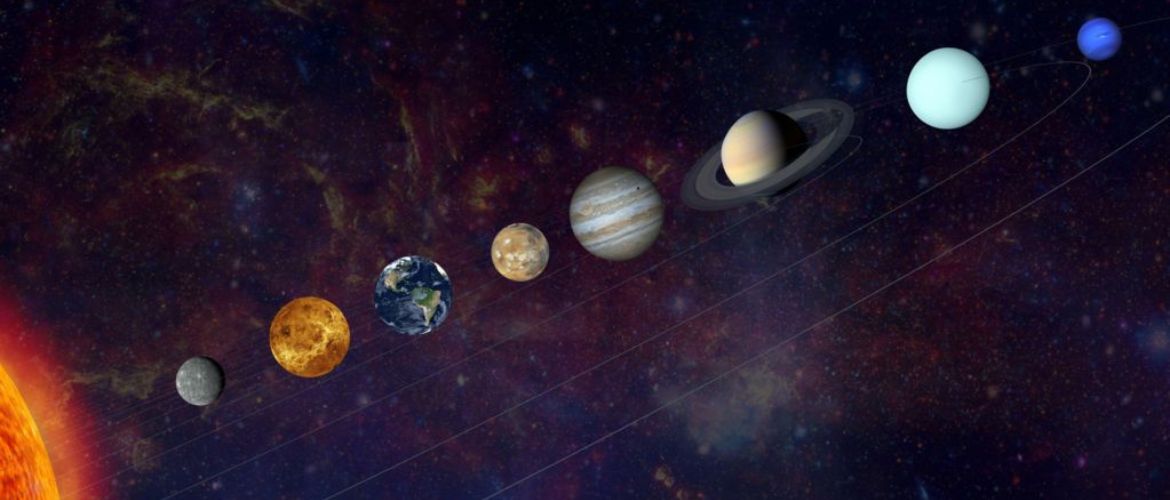

28 February 2026 will see a planetary parade — a rare celestial phenomenon in which several planets of the Solar System become visible within one sector of the sky at the same time. This refers to the motion of the planets along the ecliptic and a moment when different planetary principles are concentrated together. Read more on Joy-pup about the planetary parade in February 2026.
Which planets will align on 28 February 2026
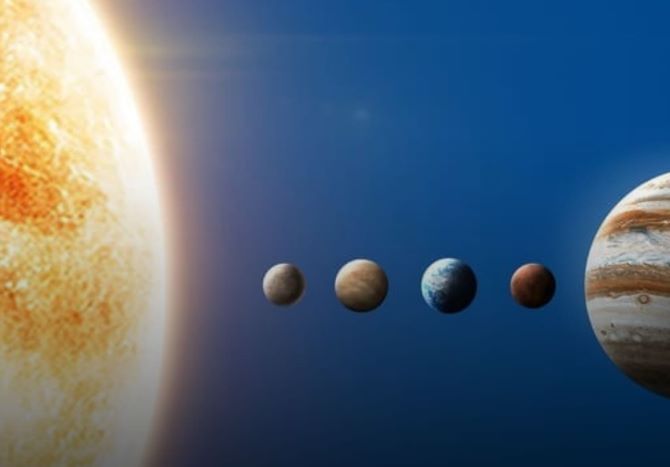
From an astronomical point of view, a planetary parade is a visual close grouping of planets on the celestial sphere, not their physical alignment in a single line in space. On the evening of 28 February 2026, six planets positioned along the ecliptic can be observed in the night sky:
- Mercury
- Venus
- Jupiter
- Saturn
- Uranus
- Neptune
What will be visible to the naked eye
- Venus — the brightest, noticeable immediately after sunset
- Jupiter — bright and clearly distinguishable
- Saturn — visible under clear sky conditions
Uranus and Neptune will require binoculars or a telescope, while Mercury will be visible low above the horizon and will require an open view and precise timing for observation. The best time for observing is 40–70 minutes after sunset, depending on latitude and weather conditions.
Although planets regularly move along the same plane, the simultaneous visibility of six planets within one sector of the sky is relatively rare. This is due to differences in their orbital speeds, their distances from Earth, and observing conditions.

What a planetary parade means in astrology
In astrology, a planetary parade is viewed not as a physical influence but as a symbolic overlap of several archetypal energies within a single time period.
Each planet carries its own principle:
- Mercury — thinking, information, decision-making
- Venus — values, relationships, money
- Jupiter — growth, opportunities, expansion
- Saturn — limitations, responsibility, structure
- Uranus — change, surprises, renewal
- Neptune — ideals, intuition, the blurring of boundaries
When these symbols are active at the same time, the period is perceived as a point of recalibration, when old patterns begin to diverge from new expectations.
Read also: favorable and unfavorable dates of February 2026 according to the lunar calendar

Only registered users can leave comments