

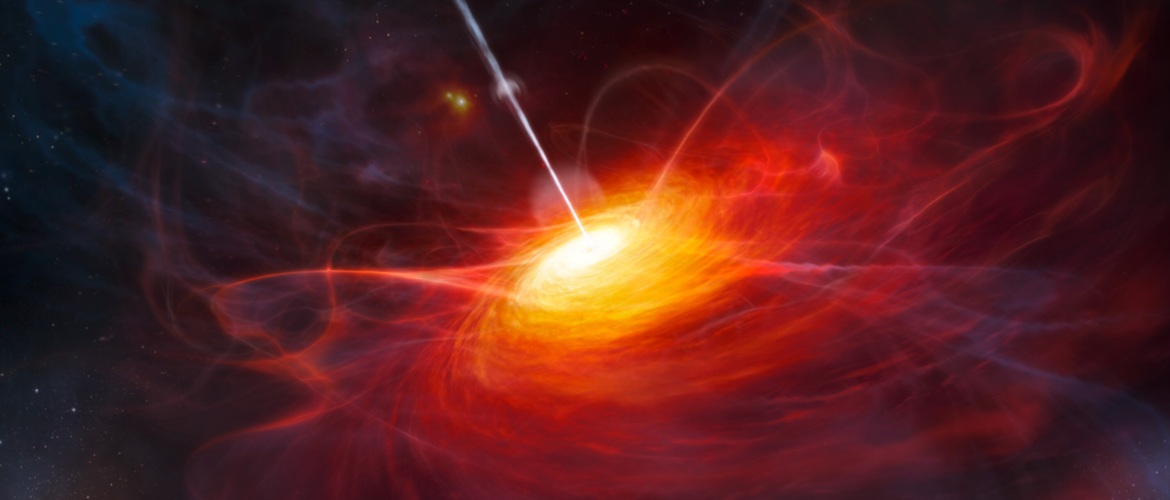

Astronomers have identified an unusual quasar, designated ID830, a supermassive black hole from the early universe that appears to have increased its mass at a rate exceeding the Eddington limit, a theoretical limit on the rate of accretion. Adding to the intrigue is the fact that the object simultaneously emits powerful X-rays and radio waves—a combination previously considered extremely unlikely.
Quasar ID830 existed approximately 12 billion years ago, when the universe was only about 15% its current age. Despite its youth, the object’s mass was already approximately 440 million times that of the Sun. For comparison, this is more than a hundred times the mass of Sagittarius A*, the black hole at the center of the Milky Way. ID830 actively draws in surrounding matter, forming a rapidly rotating accretion disk where matter moves at speeds close to the speed of light. At the same time, powerful jets of radiation erupt from its poles.
The results of the international research team were published on January 21 in The Astrophysical Journal. The scientists studied the object in various ranges of the electromagnetic spectrum to understand how it managed to exceed the classical Eddington limit.
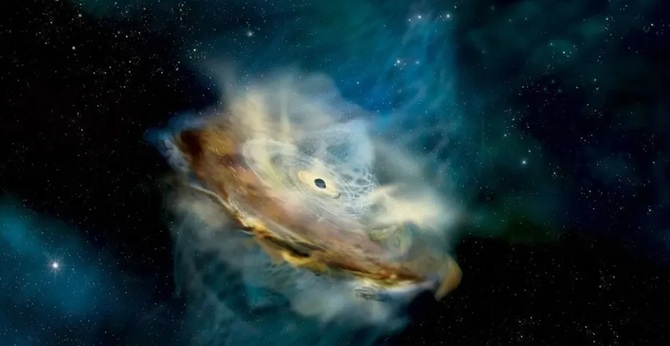
According to existing models, the growth of a black hole is limited by physical laws. As it absorbs gas and dust, an accretion disk forms around it. The infalling matter heats up and begins to radiate energy, creating radiation pressure. This pressure partially pushes matter outward, preventing it from falling further inward. It is the balance between gravity and radiation that determines the Eddington limit—a kind of self-regulating mechanism. However, researchers believe that under certain conditions, this limit may be temporarily violated. One possible scenario involves brief phases of extremely intense matter absorption before increasing radiation pressure slows the process. An alternative hypothesis is related to geometric features: matter may flow toward the black hole through the equatorial region, while radiation predominantly escapes through the poles, creating no significant obstacle to the influx of matter.
Such mechanisms partially explain how supermassive black holes formed so early in cosmic history. Observations by the James Webb Space Telescope have already indicated that such objects formed significantly faster than previous theoretical calculations predicted.
There is also a hypothesis that Population III stars—the oldest and most massive stars in the early Universe—could have served as the “seeds” of the first black holes. However, even under this scenario, future supermassive black holes would require a long period of continuous growth—more than 650 million years—near the Eddington limit, implying the presence of vast reserves of surrounding gas.
The discovery of ID830 challenges previous ideas about the formation of the first giant black holes and may require a revision of existing models of the evolution of the early Universe.
As a reminder, scientists have detected new faults on the Moon and have stated that it is shrinking.
To be continued…



Only registered users can leave comments