

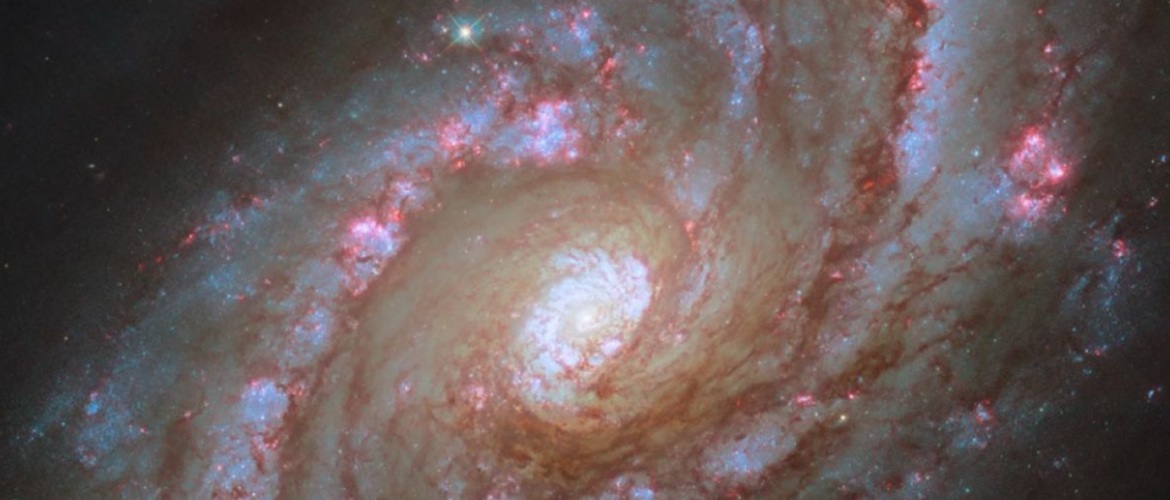


An international team of astronomers using the James Webb Space Telescope (JWST) has made an unexpected astronomical discovery.
While studying a gas-rich cosmic network node, MQN01, the scientists accidentally discovered a large red galaxy, nicknamed “Red Potato” due to its unusual shape and color.
The galaxy, MQN01 J004131.9-493704, is located in a region of high redshift (z ≈ 3.25). Cosmic network nodes are typically characterized by an abundance of cold gas, which facilitates intense star formation. However, the observed galaxy behaves completely differently. The physical properties of the Red Potato galaxy are astonishing: the galaxy’s stellar mass is approximately 110 billion times that of the Sun, and its half-light radius is approximately 3.1 x 10¹⁶ kilometers, or approximately 3,260 light-years. Despite its size, the molecular gas content is extremely low—less than 7 billion solar masses, or less than 6% of the galaxy’s total mass. The absence of characteristic spectral lines of carbon monoxide and sodium confirms that the galaxy is poor in neutral gas and does not form powerful gas outflows.

The star formation rate in the Red Potato galaxy is only about 4 solar masses per year, which is ten times lower than typical for galaxies of this type. This is especially surprising given that the galaxy is located at the center of a vast reservoir of cold gas.
Researchers believe that the low activity is due to external influences. Deep X-ray observations indicate the presence of a powerful jet emanating from a nearby active galactic nucleus. Astronomers have concluded that this influence prevents the “Red Potato” from capturing fresh gas from the surrounding cosmic web. Turbulent flows prevent the gas from cooling and settling on the galaxy’s disks, effectively halting its growth and turning it into a “quiet” system at the heart of an active protocluster. This discovery provides a deeper understanding of the processes that can prematurely end star formation in the most massive structures in the Universe.
As a reminder, scientists have discovered a lemon planet whose existence cannot be explained.
To be continued…
Only registered users can leave comments