




Astronomers have announced the discovery of a new exoplanet, discovered during observations with the Transiting Exoplanet Survey Satellite (TESS). Specialists from the National Autonomous University of Mexico (UNAM) detected a transit signal in the light curve of the star TOI-1080, a quiet red dwarf of the spectral type M4V.
Additional observations using ground-based observatories confirmed that the detected signal is caused by the planet’s transit across the star’s disk. The discovered object is slightly larger than Earth and orbits its star in less than four days.
The TESS mission is currently studying approximately 200,000 bright stars located relatively close to the Sun in search of transiting exoplanets. According to the researchers, the data obtained confirm that the object is planetary in nature and is a moderately warm rocky planet orbiting an M4V-type star.
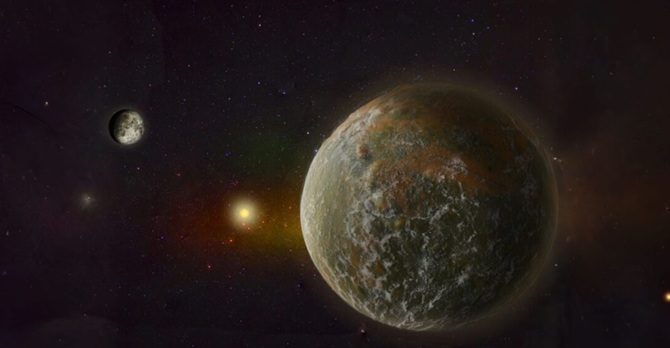
According to the study’s results, TOI-1080 b is most likely a super-Earth with a rocky surface. Its radius is approximately 1.2 times that of Earth, and the scientists estimate its mass to be no more than 10.7 Earth masses and may be around 1.75 Earth masses.
The scientists note that the planet completes a full orbit around its star in approximately 3.97 days and is extremely close—about 0.027 astronomical units. Given these parameters, its equilibrium temperature is estimated at approximately 368 K, making it quite warm, but still within the moderate range for rocky worlds.
Furthermore, the observations indicate that TOI-1080 b may be a moderate super-Earth, likely with a rocky composition. Since it is located within the habitable zone of its star, researchers suspect the presence of an atmosphere, possibly dominated by carbon dioxide or even a dense oxygen-containing layer. However, further atmospheric studies are needed to confirm these assumptions.
As a reminder, scientists have discovered a unique “super-Earth” that may harbor water.
To be continued…



Only registered users can leave comments