

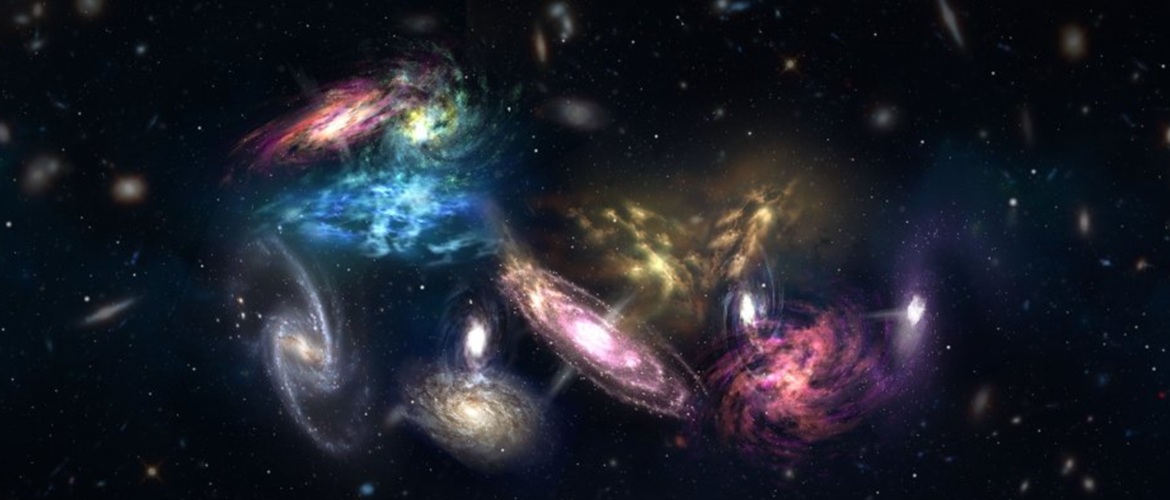


Astronomers have detected a strikingly hot gas cluster in the early Universe, which is surprising scientists with its extreme characteristics. This cluster formed just 1.4 billion years after the Big Bang and was found to be filled with gas with a temperature significantly higher than previously predicted. The results of the study were published in the scientific journal Nature.
“We were completely unpredictable about finding such a hot gas environment in a galaxy cluster so early in the Universe’s evolution,” said Dazhi Zhou, a researcher from the University of British Columbia.
Initially, the team of scientists doubted the reliability of the data and suspected that the signal might be a mistake. However, after extensive and meticulous testing, it became clear: the temperature of the gas in the SPT2349-56 cluster was indeed approximately five times higher than expected.
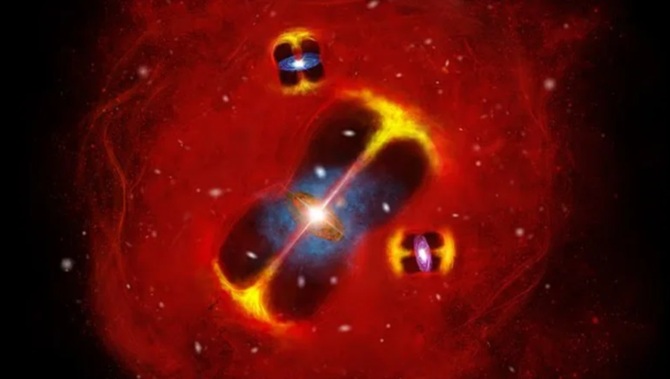
According to experts, such a colossal energy release could have been caused by the activity of three supermassive black holes located in the cluster’s central region. They likely accelerated the surrounding gas, creating extreme conditions. This discovery forces a reexamination of existing theories about the formation of the first galaxy clusters.
SPT2349-56 is considered a young but extremely massive galaxy cluster. Its central region contains approximately 30 actively forming galaxies, and the core is approximately 500,000 light-years across. Observations were conducted using the ALMA radio interferometer, and the Sunyaev-Zeldovich effect was used to estimate the thermal energy of the gas.
“Studying galaxy clusters helps us understand the formation of the largest galactic structures in the Universe,” noted Dalhousie University Professor Scott Chapman. “Their development depends largely on the environment, including hot intracluster gas.”
As a reminder, scientists have discovered a rogue planet at the center of the Milky Way.
To be continued…



Only registered users can leave comments