

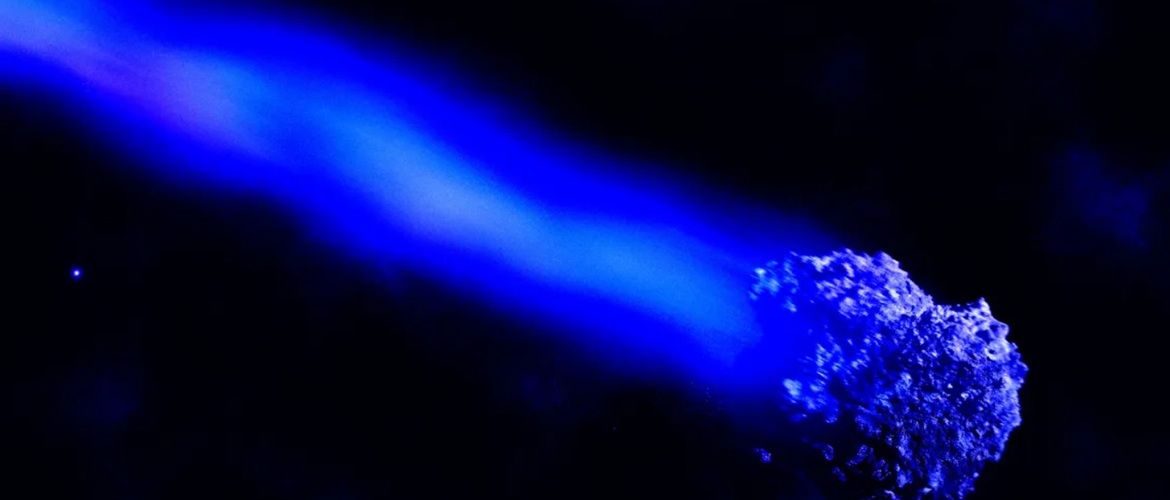


Astronomers have detected unprecedented amounts of methanol and hydrogen cyanide in the interstellar comet 3I/ATLAS—substances considered key elements for the formation of life, including DNA and RNA molecules. This third interstellar object discovered contains significantly more of these compounds than any comet in our Solar System.
Experts have determined that 3I/ATLAS contains methanol and other chemical compounds that could have played a key role in the origin of life. The concentration of methanol in the object was extremely high—methanol is one of the basic molecules of organic chemistry, involved in the formation of amino acids and proteins, which are the building blocks of DNA and RNA. However, no comet in the Solar System has ever demonstrated such characteristics, and methanol has never been detected in other interstellar objects.
Previously, scientists noted that 3I/ATLAS possesses unusual properties: it behaves differently from typical comets and has a unique chemical composition. The comet likely formed in another solar system under completely different conditions. This is only the third interstellar object identified by astronomers this year, and it is currently leaving our solar system.
During observations with the ALMA radio telescope, scientists detected significant amounts of methanol in both the comet’s nucleus and coma. They also discovered hydrogen cyanide, another molecule important for the origin of life.

Methanol serves as a precursor to amino acids, which form DNA and RNA, and plays a key role in organic chemistry. Hydrogen cyanide is toxic in large quantities, but in small concentrations it is essential for the life of plants, animals, and microorganisms, and is also involved in the formation of complex organic compounds.
Researchers note that the levels of methanol and hydrogen cyanide in the nucleus and coma of 3I/ATLAS were extremely high—unprecedented levels in any comet in the Solar System. The comet ejects approximately 40 kg of methanol per second, accounting for approximately 8% of its total emissions—four times more than is typical for comets in our solar system. Hydrogen cyanide is ejected at 250 to 500 grams per second, also a record.
Given the importance of methanol in the formation of vital molecules, this discovery is particularly interesting. Harvard University astrophysicist Avi Loeb, who previously suggested that 3I/ATLAS could be an alien spacecraft, believes that the new data supports the hypothesis that similar objects could have delivered the “building blocks” of life to Earth billions of years ago.
Loeb notes that the anomalously high concentrations of methanol and hydrogen cyanide indicate the comet’s “friendly nature” and pose no threat. The scientist previously considered the possibility that 3I/ATLAS could be a spacecraft from a hostile civilization, but current observations refute this theory.
As a reminder, scientists have calculated the exact time on Mars.
To be continued…



Only registered users can leave comments