

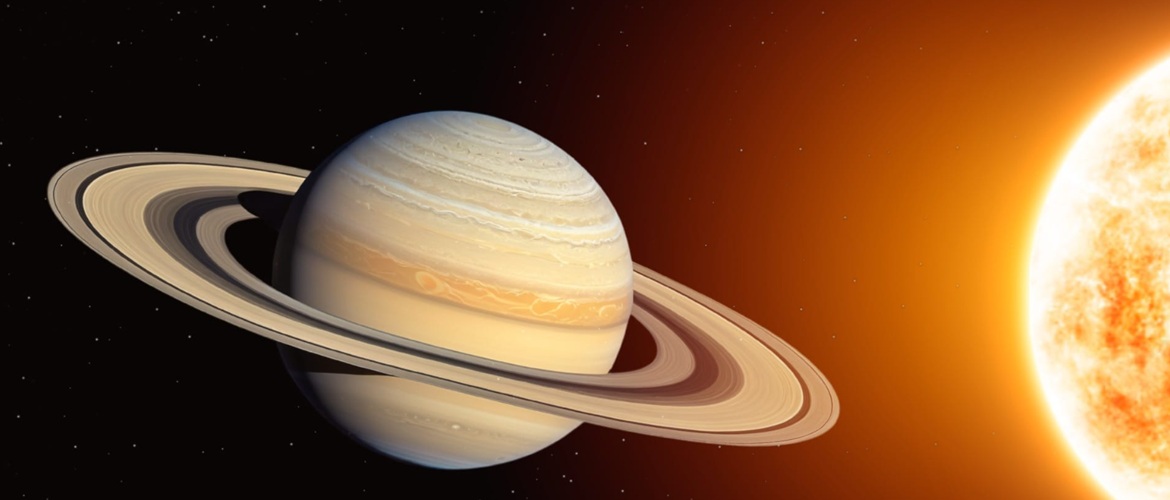

Scientists have concluded that Saturn’s magnetic field has a noticeable asymmetry and is significantly different from the Earth’s magnetic field. One of the possible reasons for this feature is the influence of the satellite Enceladus, as well as the very rapid rotation of the planet itself.
The study is based on data obtained by the Cassini spacecraft, which orbited Saturn from 2004 to 2017. Experts have studied areas where magnetic field lines begin to bend back toward the poles and send streams of charged particles into the atmosphere. These zones are known as magnetic cusps.
The analysis showed that Saturn’s magnetic cusp is shifted to the side when viewing the planet from the Sun. If we draw an analogy with a watch dial, then for the Earth such an area is located around the 12 o’clock mark, while for Saturn it is closer to 1 or 3 o’clock. This indicates the inhomogeneous structure of the gas giant’s magnetic field.
According to scientists, a key role in the formation of Saturn’s magnetic field is played by its high rotation speed – a day on the planet lasts about 10.7 hours. As Saturn rotates, it drags along a layer of dense plasma, which affects the shape and structure of the magnetosphere.
The main source of this plasma is the planet’s satellites. Enceladus, an icy moon with a subsurface ocean, plays a particularly important role. It releases large volumes of water vapor into space, which then ionizes and becomes part of the plasma environment. This is what, according to researchers, leads to deformation of Saturn’s magnetic field.
Scientists also emphasize that for gas giants such as Saturn, internal processes – rapid rotation and activity of satellites – can be decisive in the formation of the magnetosphere. This distinguishes them from Earth, where the main influence is exerted by the solar wind – a stream of charged particles from the Sun.
During the work, the researchers studied 67 cases of the Cassini spacecraft passing through the magnetic cusp between 2004 and 2010. Magnetometer and plasma spectrometer data were used for the analysis, which made it possible to simulate the structure of the magnetic field and confirm its asymmetric shape.
According to scientists, a deeper understanding of conditions in the Saturn system is of great importance for future space missions to this planet and its moon Enceladus. Such studies will help better assess the environment in this system, including in the context of searching for conditions potentially suitable for life in Enceladus’s subsurface ocean.
This discovery could play an important role in studying how stellar winds interact with planets outside the solar system.
Let us remind you that scientists have named planets where there may be extraterrestrial life.
To be continued…



Only registered users can leave comments