

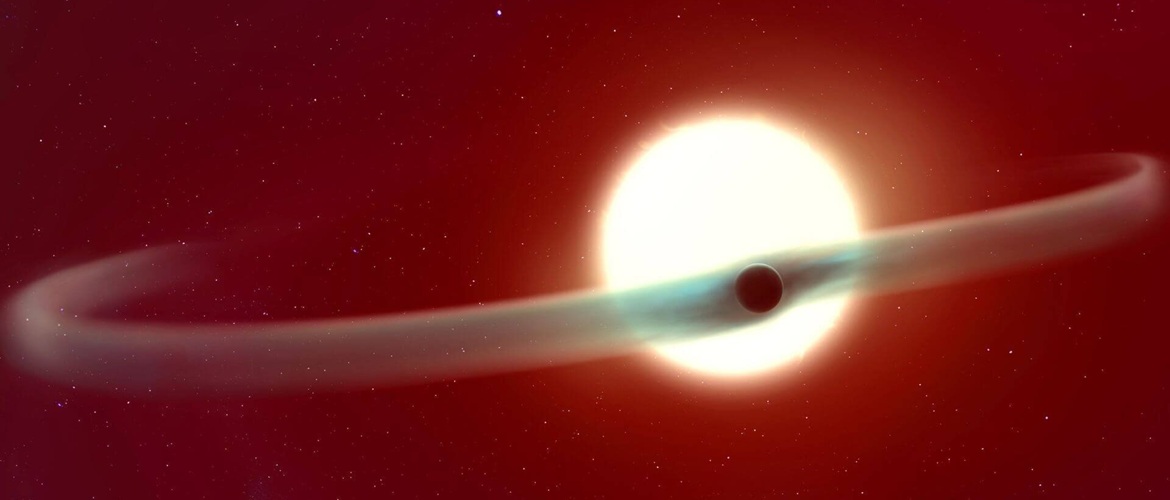


The James Webb Space Telescope has made a truly sensational discovery: for the first time, scientists have directly detected an exoplanet with two gas tails formed by its own atmosphere. It turns out that the envelope of this so-called hot Jupiter extends over almost half of its orbit, and hot gases are literally escaping into interplanetary space in two directions at once.
The subject of this detailed study was the exoplanet WASP-121b, also known as Tilos. It is an ultra-hot gas giant located approximately 858 light-years from Earth. Its mass is 18% greater than that of Jupiter, and its orbital period is less than 30 hours. The planet is extremely close to its star, causing temperatures in the upper atmosphere to reach several thousand Kelvin. Under these conditions, Tilos is rapidly losing light gases, primarily helium.
Until recently, astronomers had only suspected the presence of an atmospheric plume, based on indirect evidence obtained during transit observations. However, in a new study, an international team of scientists led by researchers from the University of Montreal conducted approximately 37 hours of continuous observations. The James Webb Space Telescope tracked the planet at all stages of its motion—before the transit, during its passage across the star’s disk, and after.
The results were impressive. Data analysis revealed that the helium atmosphere extends far beyond the planet’s gravitational field. One of the gas tails extends behind Tilos; its formation is associated with the action of stellar wind and intense radiation, which “blow away” the atmosphere. The second tail, in contrast, points forward along its orbit. The scientists hypothesize that it is formed by the complex interaction of the star’s gravity and streams of hot gas. Together, the two tails extend for a distance approximately one hundred times greater than the diameter of the planet itself.
Researchers emphasize that existing theoretical models cannot yet fully explain the formation of such an unusual double structure. New observations indicate that the process of atmosphere loss in ultra-hot Jupiters is much more complex and three-dimensional than previously thought. This discovery will help us better understand the evolution of gas giants and understand whether such planets are capable of losing a significant portion of their atmosphere over time, transforming into more compact worlds.
As a reminder, habitable habitats have been discovered on Titan.
To be continued…



Only registered users can leave comments