

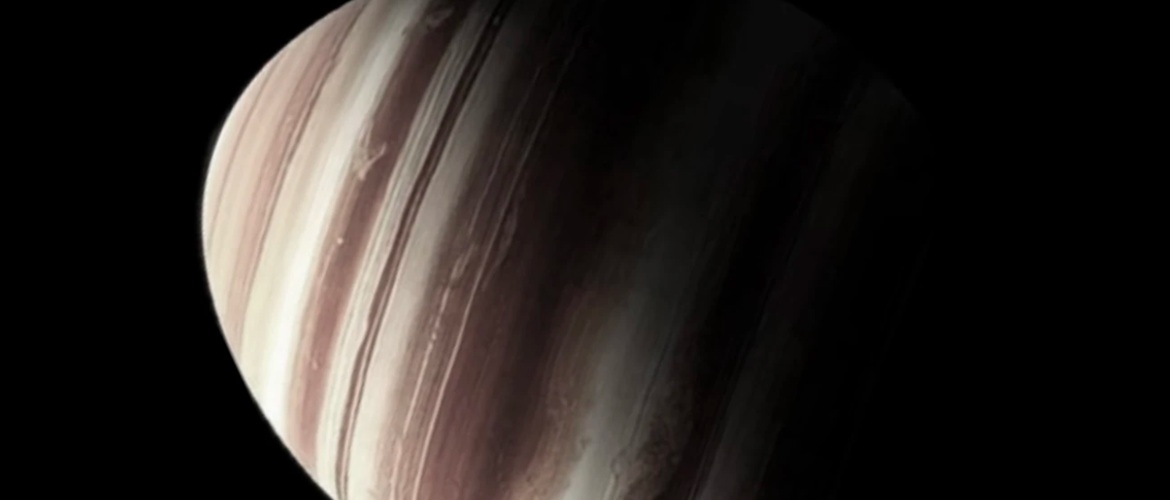

NASA’s James Webb Space Telescope has stumped astronomers by detecting the existence of a truly anomalous world. It is a gas giant comparable in mass to Jupiter, has an elongated, almost lemon-shaped shape, orbits a dead star, and exhibits a chemical composition that defies any known theory of planetary origin.
The exoplanet, designated PSR J2322–2650b, is located approximately 750 light-years from Earth. It is a unique object: of more than six thousand gas giants discovered, it remains the only one orbiting a pulsar—the neutron remnant of a dead star with colossal density, compressed to the size of a metropolis. PSR J2322–2650b orbits its star at a frighteningly small distance – just about 1.6 million kilometers. By comparison, Earth is almost a hundred times closer to the Sun. Because of this proximity, the planet completes a full orbit around the pulsar in less than eight hours.
The neutron star’s gravitational field is so powerful that it literally deforms the giant, stretching it and giving it an unusual, flattened shape. Scientists note that these conditions turn this world into a veritable cosmic hell.
The planet’s surface and atmosphere are constantly exposed to intense gamma radiation, and the temperature contrast is astonishing: the night side heats up to 650°C, while the day side can exceed 2000°C.
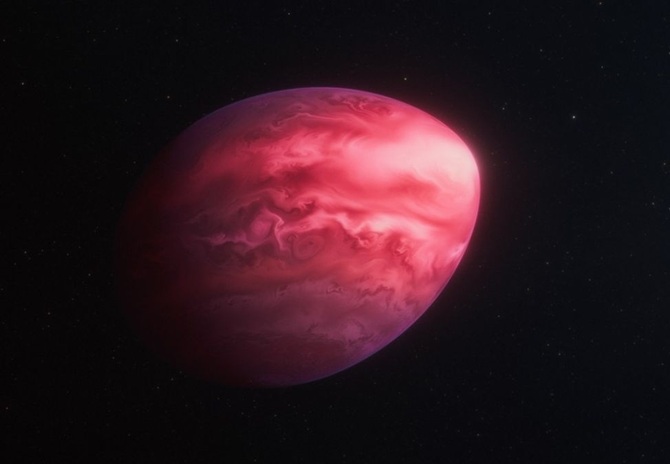
The most unexpected discovery was the composition of PSR J2322–2650b’s atmosphere. According to the researchers, they have encountered a phenomenon never before observed in any planetary object. As explained by a member of the scientific team, astrophysicist Michael Zhang from the University of Chicago, instead of the compounds typical of gas giants—water vapor, methane, or carbon dioxide—the instruments detected a predominance of pure molecular carbon. This completely challenges existing understanding of planetary atmospheric chemistry.
In the hot upper layers, clouds of carbon soot are presumably forming, while deep within the planet, under extreme pressure, carbon can crystallize, forming diamonds.
Dr. Peter Gao from the Carnegie Institution admits that the initial data left the team perplexed: they simply couldn’t believe what they were seeing, as the object was completely unlike anything they expected to find.
PSR J2322–2650b challenges all current models of planet formation. At such high temperatures, carbon typically reacts with other elements, but here it is present in a virtually pure form, indicating the absence of oxygen and nitrogen. This world could not have formed in the standard way from a disk of gas and dust, and the theory that it originated from the remnants of a star also doesn’t hold water—nuclear processes don’t create pure carbon in this form. The researchers themselves admit that no known mechanism explains the planet’s origin.
One hypothesis being considered is that carbon and oxygen could have crystallized within the planet as it cooled, but even this theory doesn’t answer the question of where the remaining elements disappeared to.
As Professor Roger Romani of Stanford University noted, such discoveries remind scientists that the universe still holds many mysteries, and it is precisely such objects that force them to reconsider established views on the structure of the cosmos.
As a reminder, a potentially habitable planet with a temperature of -70°C has been discovered.
To be continued…
Only registered users can leave comments