

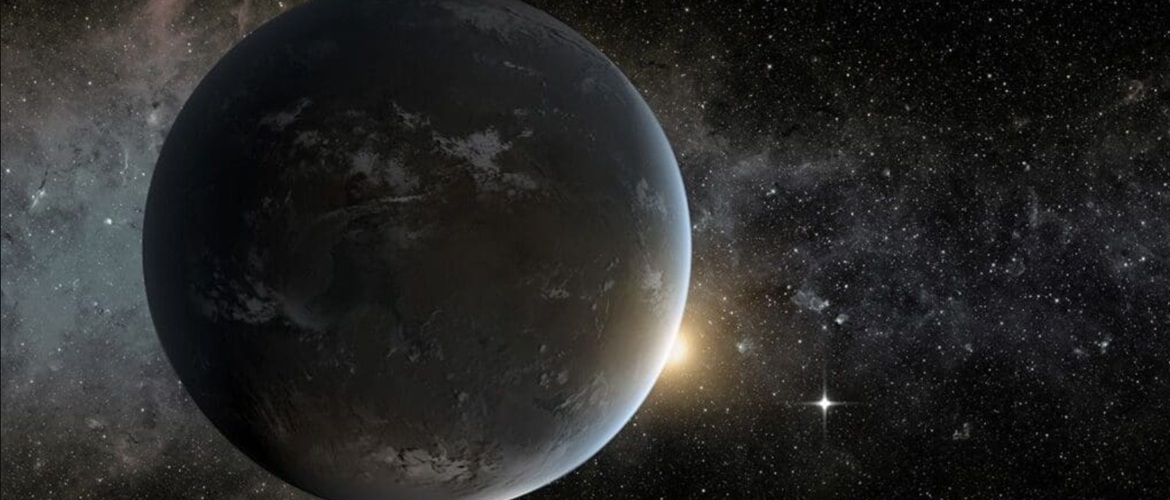

Astronomers have confirmed the presence of several planets in the system of the red dwarf star GJ 887, located relatively close to the Solar System. One of the recently confirmed exoplanets has attracted particular attention: it is located in the so-called habitable zone, where conditions for the emergence of life could theoretically exist. This is why this object is considered a promising candidate for the search for extraterrestrial biosignatures.
The star GJ 887 is a bright red dwarf located approximately 10.7 light-years from the Sun. By cosmic standards, this distance is considered relatively small, making the system convenient for detailed observations and future research.
Just a few years ago, in 2020, astronomers already suspected the existence of two planets in this system. They orbit the star in a relatively short time—approximately 9 and 21 days. At the same time, scientists noticed an additional signal that could indicate the presence of a third celestial body with an orbital period of approximately 50 days. However, at that time, data was insufficient: the signal could be caused not only by the planet, but also by the magnetic activity of the star itself.
Red dwarfs have long been considered one of the prime targets in the search for potentially habitable worlds. Such stars are smaller and cooler than the Sun, meaning their habitable zone is located closer to the star, facilitating the detection of small Earth-like planets.
To finally clarify the situation, an international team of researchers conducted a more detailed analysis. The scientists combined new measurements of the star’s radial velocity with archival data from high-precision spectrographs and also added photometric observations obtained by the Transiting Exoplanet Survey Satellite (TESS).
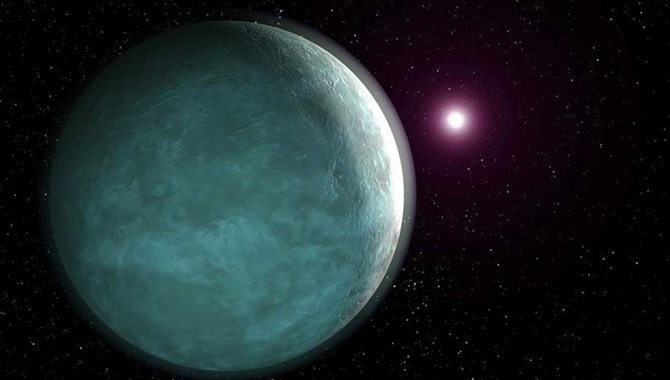
The results of the study showed that at least four planets orbit GJ 887. Their orbital periods are approximately 4.4, 9.2, 21.8, and 50.8 days. Of greatest interest to scientists is the planet with a period of 50.8 days, designated GJ 887 d. It lies within the habitable zone of its star and is considered one of the closest such planets to Earth, second only to Proxima Centauri b.
According to astronomers’ calculations, this planet belongs to the class of so-called “super-Earths.” Its minimum mass exceeds six Earth masses. However, the precise composition of the celestial body is currently unknown. Without precise data on the planet’s radius, it is impossible to calculate its density, and therefore to determine whether it is rocky, water-rich, or a loose sub-Neptunian world.
In addition, scientists have detected another potential signal with a period of approximately 2.2 days. If further observations confirm its nature, the system may contain another planet, possibly even smaller in mass than Earth.
The proximity of GJ 887 and the characteristics of its planetary system make it one of the most interesting targets for future astronomical research. Planet GJ 887 d is considered particularly promising: future space missions will be able to study its atmosphere and check for possible signs of life.
According to researchers, the GJ 887 system will remain a focus of scientific attention for a long time. The presence of several planets around a relatively nearby and bright star makes it an ideal laboratory for studying the formation and evolution of planetary systems, as well as for searching for potentially habitable worlds.
As a reminder, scientists have determined the true age of planet Earth.
To be continued…

Only registered users can leave comments