

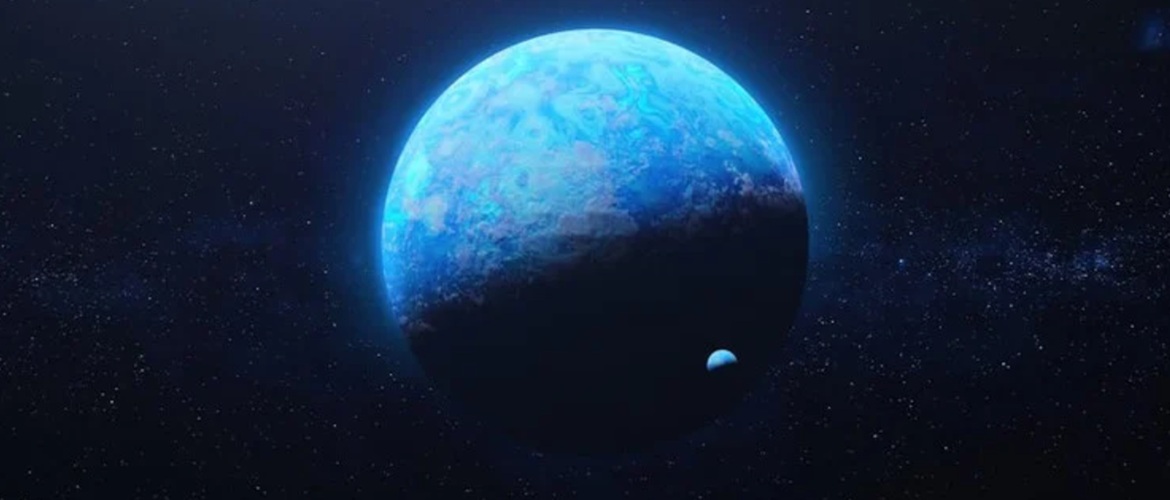

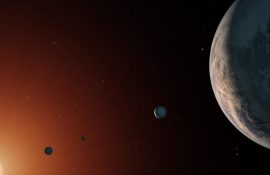
The American aerospace agency NASA announced the discovery of an unusual exoplanet, whose characteristics are very similar to those of Earth. According to scientists, liquid water could potentially exist on its surface, and its atmosphere could be suitable for life.
The discovered object has been designated HD 137010 b. The planet is located approximately 146 light-years from our planet and orbits a star similar to our Sun, but less luminous and cooler. This means that possible life forms on HD 137010 b must be adapted to lower temperatures.
The exoplanet was discovered by NASA specialists using information obtained by the Kepler space telescope. A single transit played a key role—the moment when the planet passed in front of its star, causing a slight dip in brightness. Even this brief observation was enough to determine the basic parameters of its orbit.
By analyzing the speed of the planet’s shadow across the star’s surface, the researchers concluded that the length of a day on HD 137010 b is approximately 10 hours, compared to 13 hours on Earth.
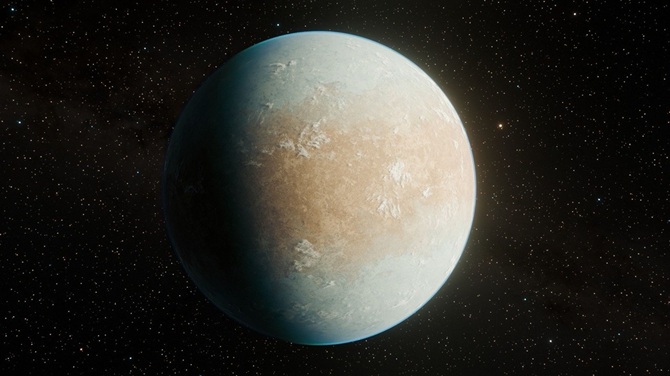
According to calculations, the planet’s climate is most likely cold. However, NASA emphasizes that, given a dense atmosphere with increased carbon dioxide content, conditions could be moderate or even favorable for aquatic life.
The scientists also modeled the possible atmospheric composition and concluded that the probability of HD 137010 b being in the so-called “strict habitable zone” is approximately 40%. If expanded criteria are taken into account, this figure increases to 51%, making the planet one of the most promising known exoplanets. However, it is still impossible to definitively confirm the habitability of this world. Experts acknowledge that further research will face significant technical challenges.
NASA explains that HD 137010 b’s orbital distance is almost identical to Earth’s, making transits extremely rare. This is one of the main reasons why exoplanets with Earth-like orbits are so difficult to detect.
It is likely that obtaining more detailed information about HD 137010 b will only be possible with the advent of next-generation space telescopes capable of more precise and extended observations.
As a reminder, scientists have discovered a black hole that was resurrected after 100 million years.
To be continued…
Only registered users can leave comments