

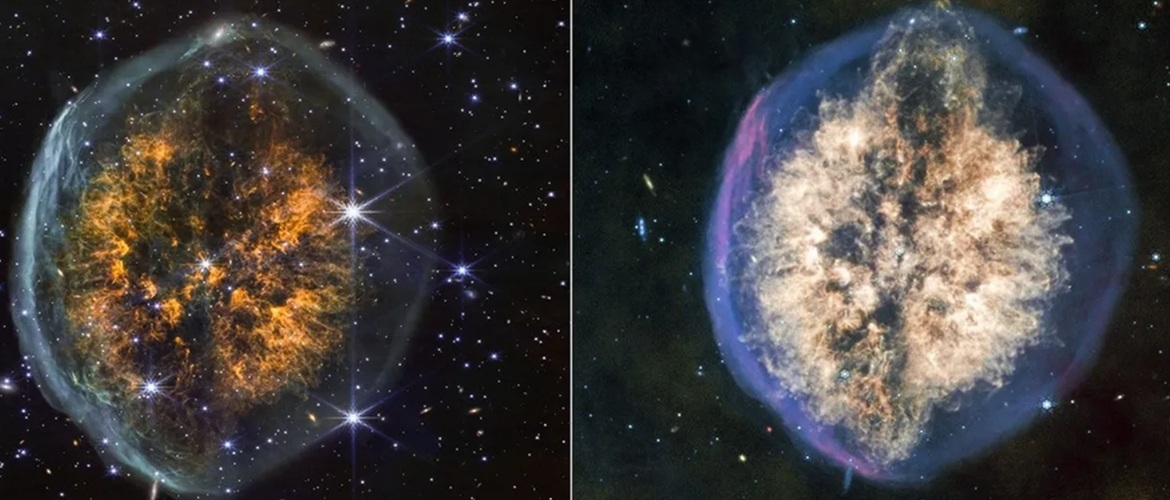

The James Webb Space Telescope has peered inside the mysterious nebula PMR 1, better known among astronomers as the “Naked Skull.” New images have revealed incredible details of this object—the final stage of a star’s life, its structure resembling a brain encased in a transparent skull.
The nebula is located approximately 5,000 light-years from Earth in the constellation Vela (Sails). The name PMR 1 is derived from the initials of the last names of astronomers Parker, Morgan, and Russell, who first observed it in the late 1990s using the 1.2-meter Schmidt telescope at the Australian Astronomical Observatory. In 2013, the object was studied in infrared light using the Spitzer Space Telescope, and its unusual appearance earned the nebula its iconic nickname.
For the new observations, the James Webb spacecraft used the NIRCam camera for near-infrared images and the MIRI instrument for mid-infrared images. The high resolution allowed for a detailed examination of the complex internal structure of the gases that form the “brain,” which is surrounded by a thin shell of hydrogen, creating a “skull” effect. Scientists believe the outer shell was ejected earlier and has already cooled, while the inner part contains recently ionized gases.
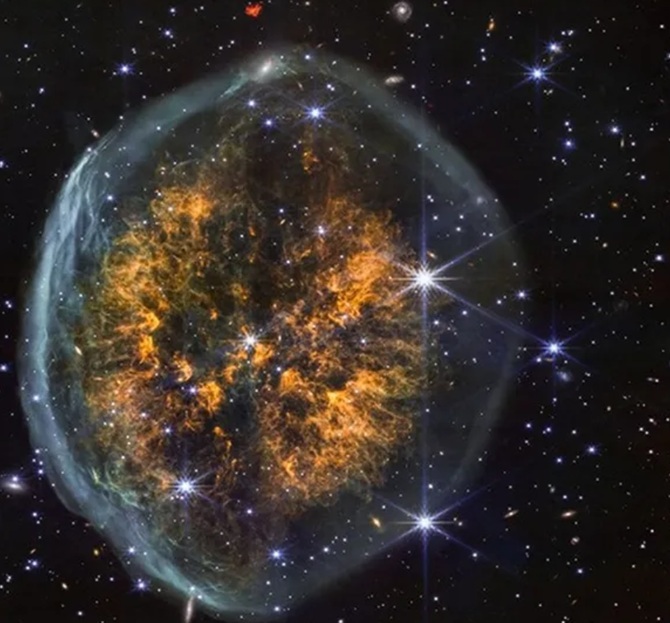
Astronomers are particularly interested in a deep rift in the center of the nebula, visually dividing the “brain” into two halves. It is believed to have been formed by the polar jets of the dying star. Images obtained with MIRI show how ionized gas is breaking through the hydrogen shell at the top of the object. If this is confirmed, scientists will be able to more accurately determine the orientation of the central star relative to the nebula.
However, the nature of the central star itself remains a mystery. When the nebula was discovered in the 1990s, spectral data suggested that it may be a Wolf-Rayet star—massive and unstable stars, potential precursors of supernovae. However, there is still no definitive confirmation of the presence of such a star within PMR 1 or its sister PMR 2.
Therefore, researchers are considering an alternative theory: perhaps the Naked Skull is a common planetary nebula. In this case, it was created by a less massive star, similar to the Sun, which, during its red giant phase, shed its outer layers and is gradually turning into a white dwarf.
As a reminder, a black hole growing faster than expected was discovered in the early Universe.
To be continued…



Only registered users can leave comments