



NASA’s Perseverance rover has discovered anomalously high nickel concentrations in ancient Martian rocks. This may indicate that billions of years ago, a much more complex and chemically rich environment existed in this region than previously thought.
The discovery was made in the Neretva Vallis region, and its composition resembles mineralogical structures on Earth, which are sometimes associated with possible microbial activity. However, scientists emphasize that this is not proof of life on Mars, but rather additional evidence that conditions there could have been potentially favorable for biological processes.
Since landing in February 2021, the rover has been exploring the Jezero crater, an ancient basin approximately 45 km in diameter, which is believed to have once been a lake. According to Dr. Henry Manielski and his colleagues from Purdue University, the crater’s structure displays clear traces of ancient aquatic activity: river channels, layered sedimentary deposits, and other geological signs of water.
Perseverance later reached Neretva Vallis, an ancient riverbed where rocks dating back approximately 3 billion years have been preserved.
To analyze the rocks, the rover used a suite of scientific instruments: laser spectrometers, infrared sensors, and X-ray systems. According to data published in Nature Communications, nickel was detected in 32 of the 126 samples analyzed, with its content reaching up to 1.1% by mass.
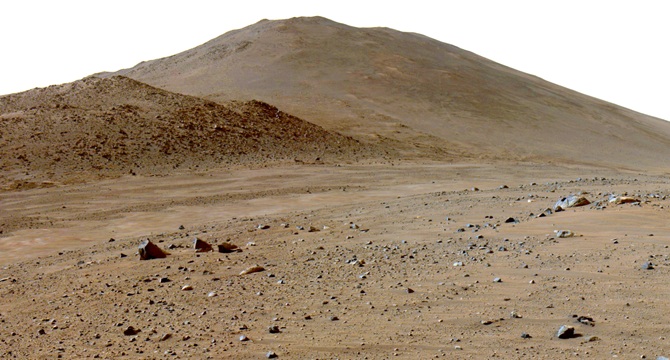
According to Manielski, nickel is typically considered a trace element on Earth and Mars, as it is primarily absorbed into the core during planetary formation. Therefore, its significant presence on the surface is of interest and helps better understand the processes of rock formation and subsequent rock transformation.
This is the highest nickel level ever recorded in Martian bedrock. Furthermore, it was found along with iron sulfide minerals and sulfates, such as jarosite and akaganeite—compounds formed by the gradual breakdown of rocks.
On Earth, nickel-bearing iron sulfides are found in ancient sedimentary layers. Such minerals are easily broken down in oxygen-rich environments, so their preservation in ancient rocks often indicates that Earth’s early atmosphere was oxygen-poor.
Scientists note that the Martian minerals in this region are remarkably similar to pyrite, a common iron sulfide on Earth. On our planet, such formations are often associated with microbial processes, especially in low-oxygen environments and the presence of sulfates and iron.
Iron sulfides and organic carbon compounds were also found in the same rocks. This combination can arise through both biological processes and purely chemical reactions.
According to the researchers, the presence of nickel-rich rocks could theoretically have created conditions under which potential ancient Martian microorganisms would have had access to this element in a bioavailable form. However, the origin of the nickel remains unclear. It may be related to volcanic activity and the disintegration of local rocks, as well as to the contribution of nickel-bearing meteorites.
Scientists emphasize that further research is needed to accurately determine the source of the nickel in Neretva Vallis and understand whether there is a connection between this element and organic matter in the region.
As a reminder, scientists have discovered a planet with an unexpected atmosphere.
To be continued…



Only registered users can leave comments